Mr. E. M Walcott was the first (1st) owner before 1934

Our Story
Our History
The story begins before 1934, when Mr. E. M. Walcott became the first recorded owner of Hope Estate. Under his stewardship, indentured laborers from India cleared and developed the estate—initially cultivating sugarcane. Eventually, Mr. Walcott diversified into coconut farming.
In 1955, the estate changed hands to Aman and Amin Sankar, who purchased it from Mr. Walcott for GY$ 74,000. The Sankar brothers expanded the land’s coconut cultivation program, shifting the estate’s focus toward this emerging crop.
Later, in 1981, former President Forbes L. S. Burnham acquired the property from the Sankar family. Burnham introduced a self‑help system at the estate and continued to expand coconut cultivation across the lands. Under his leadership, the estate was incorporated as Hope Coconut Industries Ltd, overseen by a board of directors until his death in 1985
From 1987 to 1992, the operation was managed by NEOCOL (National Edible Oil Company Limited). In 1992, the Government of Guyana assumed full control, phasing out coconut cultivation in parts and renting land to small farmers for cash crops. The state has retained ownership ever since

walcott1

walcot2
Mr. E. M Walcott was the first (1st) owner before 1934

walcot3
Mr. E. M Walcott was the first (1st) owner before 1934

walcot3
Laborers harvesting coconuts at Hope Estate

history2
Laborer climbing coconut palm at Hope Estate

history3
Mr. Burnham on horseback, his mode of transportation at Hope Estate.


Coconut Seedlings
Renewed Growth: 2020 to Present
Entering the new decade, Hope Coconut Industries Limited (HCIL) was facing significant challenges. By early 2020, the estate had fallen into poor financial condition—bank balances were reportedly as low as GY$ 120,000, staff salaries were delayed, and critical infrastructure had deteriorated. From 2015 to 2019, however, income had rebounded from GY$17 million to GY$36 million through improved management and government support
Our Mission Statement
To promote the development of the coconut value chain in Guyana with a balance between industrial production and small scale production and with effective contributions from all stakeholders including farmers, processors and marketers and government support institutions.
In mid‑2020, the Government injected GY$60 million into HCIL to overhaul drainage and irrigation systems, repair access roads and bridges, and restore estate facilities. A reconstituted Board and more disciplined management were introduced to resolve longstanding issues and address farmer concerns proactively
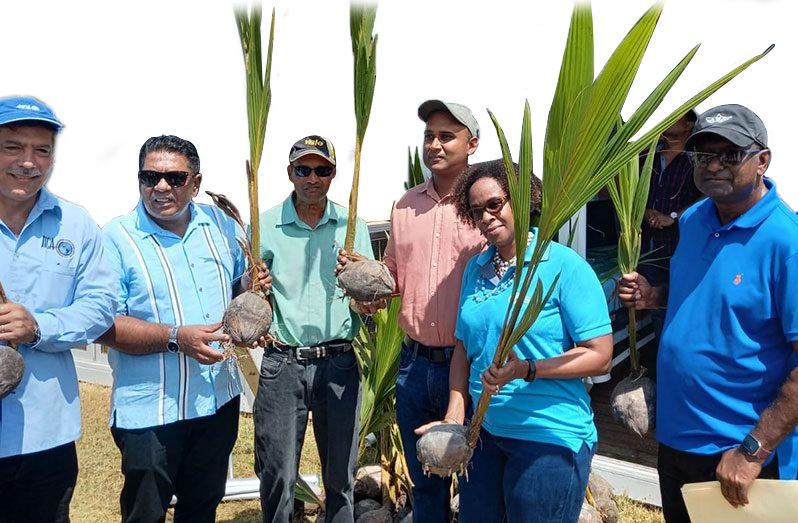
As part of a broader strategy to decentralize seedling production and expand industry access, two coconut nurseries were launched in Charity and Kairuni in late 2020. These facilities, capable of producing around 25,000 seedlings annually, marked the first phase of national expansion efforts led by HCIL and the Ministry of Agriculture
By 2021, an additional GY$70 million was allocated in the national budget to allow HCIL to establish four more nurseries, located in Wakenaam, Leguan, Canal Number Two, and Benab (Corentyne). These nurseries enhanced the estate’s capacity to around 48,000 quality seedlings per year.
The expansion led to a sharp rise in production and impact. Whereas only 4,905 seedlings were produced in 2020, over 33,000 were grown in 2021. The surge enabled 115 farmers across six administrative regions to plant coconuts on 1,845 new acres, organized into 50 farmers’ groups with support from NAREI
The coconut sector delivered robust export performance: earnings climbed to GY$2.5 billion in 2021, up from GY$1.9 billion in the previous year. Increases were driven by virgin coconut oil (GY$685 million) and dry coconut (GY$1.8 billion), making coconut the third-largest agricultural export after rice and sugar
In December 2022, HCIL and the Caribbean Agricultural Research and Development Institute (CARDI) launched the high-yield Brazilian Green Dwarf coconut variety in Guyana. The first shipment of 1,000 seed nuts arrived in October 2022, offering improved pest resistance, sweeter water content, and higher output—a key milestone in Guyana’s coconut breeding program
Through sustained capital support, institutional reforms, training programmes, decentralised nursery expansion, and varietal innovation, Hope Estate has re-emerged as the cornerstone of Guyana’s coconut industry revival.
Get Updates And Stay Connected -Subscribe To Our Newsletter
Hope Coconut Industries Ltd.
Hope Coconut Industries Ltd. started cocounut cultivation in 1934. The estate was later bought by the Governmnet where it reamains under their control. Read More.
Contact Information
- +(592) 663-2709
- rickyroopchand1970@gmail.com
- East Coast Demerara, Plantation Hope Estate
© 2025 | Developed by LOGIX